Subscribe via:



Show Summary
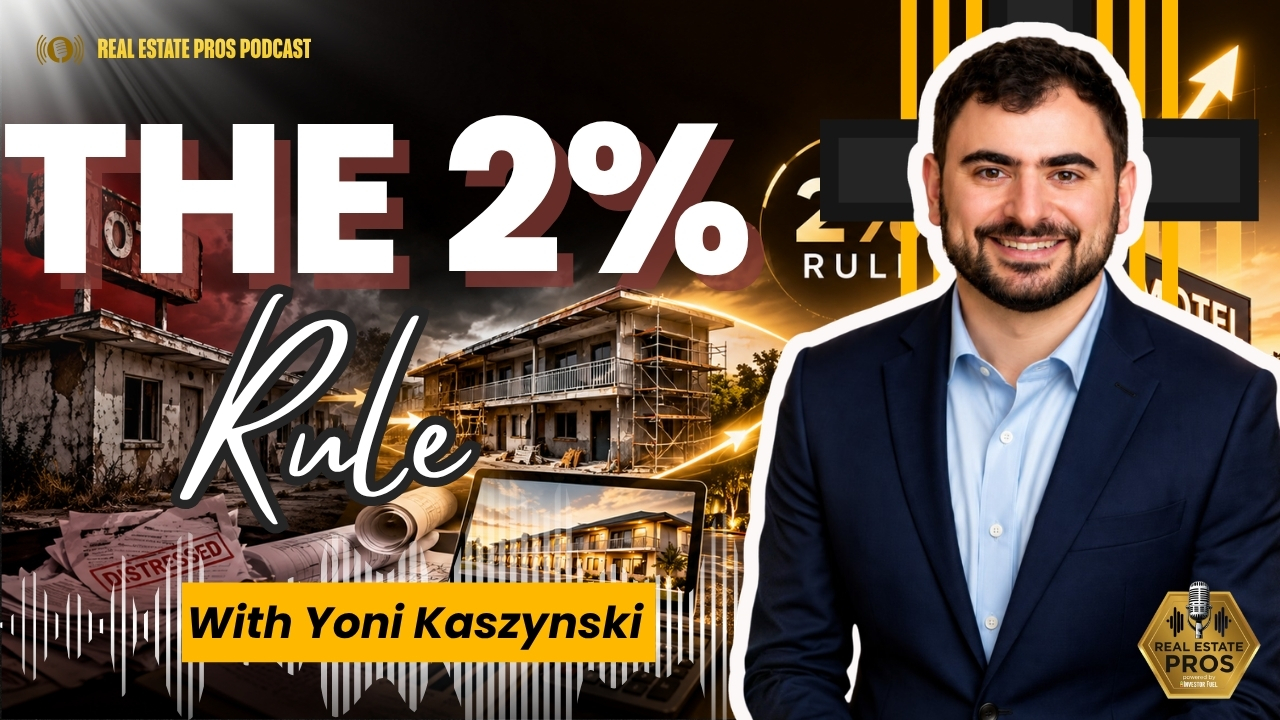
Yoni Kaszynski, founder of Cascade Coliving, joins host Scott Bursey to explain how renting by the room makes real estate cash flow in expensive markets where regular rentals no longer do. He breaks down why Pierce County beats King County on cash flow, how PadSplit’s arrival grew the Seattle room-rental market from about 30 rooms to 130 this year, and the underwriting standards he lives by: aim for 2% of the purchase price in monthly rent, never accept less than 1%, and buy so a property still covers its mortgage at half occupancy. He also covers tenant screening and why parking is the key to keeping neighbors happy.
Chapters
0:00 Why a rental should make money today
1:09 Meet Yoni Kaszynski of Cascade Coliving
2:03 Why rent by the room when regular rentals don’t work
5:04 Screening tenants in coliving
6:21 Pierce County vs. King County cash flow
8:54 How PadSplit is growing the Seattle market
10:05 Underwriting: half full and the 2% rule
11:37 Parking, neighbors and the legal gray area
13:48 The 1% minimum and advice for new investors
Resources and Links from this show:
Listen to the Audio Version of this Episode
Investor Fuel Show Transcript:
Yoni Kaszynski (00:00)
Well, I think at a bare minimum you should be hitting one percent. One percent will cover your costs. but a lot of people and I think between like twenty twenty and twenty twenty two, twenty three, they they saw this crazy appreciation where prices are going up ten percent, twenty percent a year and they thought that would last for for maybe longer. And they would say, I can something that loses money ’cause eventually the rents will go up and the value will go up and and I’ll make money then And I think that’s terrible advice. It should make money today or at the very least break even, but you shouldn’t be
paying money for something that loses you money unless you have a really good plan. But in for the vast majority of people, that’s not a good idea.
Scott Bursey (01:09)
Welcome back to the Real Estate Pros podcast, powered by Investor Fuel. I’m your host, Scott Bursey. Glad you’re with us. Today we’re pleased to have Yoni Kaszynski.
Joining us. Yoni is the founder of Cascade Coliving, who manages over 50 room rental units across the Pacific Northwest. Yoni brings top-tier project management discipline from his work at PWC and United Airlines straight into real estate underwriting. Listeners, you can expect strategies on building reliable cash flow through coliving and why taking action beats waiting for a perfect deal.
Yoni, welcome to the show.
Yoni Kaszynski (01:49)
Thanks for having me, I appreciate it.
Scott Bursey (01:51)
It is just awesome having you here, my friend. And to help our listeners get up to speed, please give us the ninety second highlight reel of how your career ignited and where you’re pouring your fuel now.
Yoni Kaszynski (02:03)
Sure. So I think just coming from a background of like supply chain and thinking of and the different jobs I’ve had of thinking of things like sequentially and you know, orderly and and kind of with patterns and things like that, is kind of thinking like what makes sense, just you know, with like everything’s like a math problem, right? In real estate it’s like obviously you want your revenues to be higher than your expenses. That’s any business, right? So I think for me when I started in real estate in twenty five,
You know, that was my first investment and and at that time a lot of investors were just pausing, like, I don’t know what to do. The rates are high, the prices are high, and they kind of just froze. So me, I wanted to take action and like I said earlier, like I think taking action beats waiting. I there’s a balance to it. You don’t want to be reckless and just like buy anything the second you see it and not analyze it. But you don’t want to a over analyze and I think some people some people call that analysis paralysis. So what I th basically saw is hey, like
Renting individual apartment units or homes doesn’t really make sense. But if you dissect it down to the room level, that does make sense. and so I started renting rooms just because nothing else really worked. That just made the most logical sense to me. And then I just kept doing that and and doing more of it. And then I found that, you know, PadSplit came to Washington and we can talk a little bit about that in a second. And that kind of is like I said earlier, kind of like the thing of the Airbnb of rent by room at
a pla a technology platform, a booking platform. And then what I’ve seen is other investors were interested in getting into it, but they didn’t want to take on the management. They said, Okay, well let me fill that fill that gap in there. And they said, Well, you know, what why don’t I get, you know, my real estate license at the same time and help other people find these properties. And again, with having the the management in house, that kind of helps that kind of helps fill that gap of, hey, I want to invest, especially if they’re busier people, right? But I don’t want to deal with the the day to day stuff. So
Scott Bursey (03:43)
Well, thank you for sharing your background. I find that really fascinating. And Yoni, you know what really caught my attention about you was the way you’ve been able to take construction planning systems from corporate giants and adapt them to scale room rentals across the Pacific Northwest. Taking that a step further, curious to know what strength gives your room rental model its biggest.
advantage today.
Yoni Kaszynski (04:10)
Honestly, I think it’s like the people I know. I know people like I have a close friend in Texas and he has seven hundred rooms under management there. And so being able to talk to him and see see what he sees the good things he’s done, see mistakes that maybe he maybe not he’s made, but maybe some of his clients have made and and and just kind of live through other people’s experience before you can see the good that’s happened and maybe the the things that can be improved. And so honestly I think in coliving where I learned the most was probably Facebook groups and the coliving conference, which
just had its second year in Denver this year. And so just I think networking has been s a good strength and I’ve I’ve learned a lot through just meeting people. And I’ve met most of my clients through that way as well. So just being it going on shows like this or just talking to people and having a conversation and sharing some dinner with people, you can learn a lot. So
Scott Bursey (04:55)
Appreciate you highlighting that. Yoni, love to hear. What is the biggest challenge in managing coliving properties right now in in your view?
Yoni Kaszynski (05:04)
I think that the biggest challenge and I would say it’s also an opportunity, right? Is that generally the people renting rooms, they’re renting a room because they can’t afford an apartment or a house, right? So you’re dealing with slightly lower income people. The you gotta be very careful screening. but there’s through that, you know, you do have some just people who don’t make a lot of money that ha just they pay and they don’t cause problems. That’s the vast majority of But it’s just like anything else in every group there are there’s some bad apples that kind of
make the rest of the group look bad. So you just gotta be very, very careful of of your screening. but again, that’s also an opportunity, right? Because if they can’t qualify for an apartment, they gotta live somewhere. So I’m filling that demand.
Scott Bursey (06:21)
Yoni, walk us through, if you will, where are you seeing the the best cash flow opportunities in room rentals today, not only in your market, but as you think about expanding markets.
Yoni Kaszynski (06:33)
Yeah, so I think if you were to say where’s the best cash flow in coliving, it I the market I’m in I don’t think is the best. It’s just Washington’s kind one of the more expensive states for real estate. but you look at I think Texas has historically been pretty good. The thing is though, where there’s good cash flow, the saturation happens faster ’cause more investors pour into the places to get fast wins. So and you also gotta think of kind of the history of Passport. So Passport started in Atlanta, then moved to Florida.
And then kinda moved west. I actually they did I think Atlanta, Houston, the rest of Texas, then Florida, and then some of their other larger markets are Arizona, which is the kind of like the Sunbelt states, right? And then they’ve started moving up the East Coast and the West Coast. and just like any other real estate, the coastal markets are more expensive. so being in a coastal market, I think like there is no cash flow any other way than coliving unless you
you’re able to buy something super, super cheap or finance it creatively or something like that. But if you’re just trying buying it normally and renting it normally, it’s not gonna work. So I think if you were to look at the like the Seattle area where I’m at, I think Pierce County will get generate you significantly better cash flow than King. So Pierce County is the Tacoma area and and King County is the Seattle area, if you’re not familiar with that. I mean what I found through the rooms that I own and the ones I’m managing for others, because I’m in both counties now, is that
the property price difference between King and Pierce is like double. So an average home and and Pierce is like six hundred thousand, an average home in King is over a million. But the rent difference is not that significant. So the average rent I’m getting in Pierce is like two fifty to two seventy five per week. And the average rent I’m getting in King like three hundred. So it’s a difference of a hundred dollars in change a month, which is like fifteen percent if that. But the cost of buying the property is like double.
So if you think of the cash flow math, obviously the cash flow is gonna be higher in in Pierce. So
Scott Bursey (08:54)
Great insight there. And expanding on your point with the local market there and in Washington, the Seattle area specifically, help us understand what local market shift is keeping you alert or on your toes in let’s just say the Pacific Northwest.
Yoni Kaszynski (09:12)
PadSplit coming, I think, has increased the demand the appetite for investors to invest because now they have a platform that helps them and and you know they have more structure to it and that’s also helped me invest and continue growing as well. Currently, when I launched on PadSplit in the Seattle area, I think there were thirty rooms on PadSplit. And now, and that was in the beginning of this year, call it like March or April.
And now there’s 130 rooms. And if you track that growth to other markets, we’re a little bit slower just because the cost is higher here. But I I mean, within I think about ten years less than that, Atlanta went from zero to over ten thousand rooms. So there’s the potential for us to grow there. And I think too, like in places where it’s more expensive, I think the growth will be slower, but demand is higher because it’s
the affordability problem is more severe. So there’ll be more opportunity and I don’t think we’ll get saturated as quickly.
Scott Bursey (10:05)
What’s your backup plan if rates or market rules shift against you?
Yoni Kaszynski (10:10)
Well, that’s a good question. Honestly, I don’t really anticipate that happening. I think that I mean my underwriting is pretty strong where generally I I try to buy a property where I can be half full and still pay my mortgage. And before I’d even get to occupancy that low I would I’d cut my prices to keep my occupancy higher. So I think that buying with pretty fat margins is is important to be able to withstand fluctuations.
Scott Bursey (10:34)
Thanks for framing it that way. Managing downside risk is is essential. Yeah it really is. And looking at the data, what underwriting standard keeps you from overpaying on cash flowing assets?
Yoni Kaszynski (10:47)
Yeah, so I think having a pretty substantial margin, being understanding that hey, things are gonna break, you’re gonna have to pay for that. If let’s say my mortgage is four thousand and I bring in five thousand, a thousand dollars is not profit. I th like some of that has to be set aside for things breaking for vacancy and understanding that those are real costs and that’s gonna happen and that that needs to be included with your underwriting. But I like to say I like to try to get as close to two percent as possible. So like back in the day there was the one percent rule.
Which is no longer achievable on normal rentals, but let’s say you pay a hundred thousand for a house or a condo or something, you should be collecting a thousand bucks a month in rent. The condo, I guess you you’ll have HOA in there, so you gotta back that out. But n I try to get as close to two percent as possible. So for example, we we I paid seven fifty for a property and I’m collecting almost fifteen thousand dollars in rent on on that same property, so that’s almost two percent per month.
Scott Bursey (11:37)
Yoni, for our listeners who are are listening and they’re thinking to themselves, hey, this is quite fascinating. What would you like them to know first about the way you do business at Cascade Coliving?
Yoni Kaszynski (11:48)
Well, I think about coliving in general, right? Like I think that not every house is a great fit, not every neighborhood’s a great fit. The legality I wouldn’t say it’s illegal, but you know, you don’t wanna do I I would say it’s it’s stomach gray. Like there’s no laws necessarily against it, but there’s no laws regulating it either, in many states. And so being cognizant of where you are in the neighborhood you are in, like you don’t wanna do it in the HOA. And you don’t wanna
I mean, generally I think the most important thing is the parking, right? And because most neighbors I don’t think really care about what’s going on in people’s houses, but when they start doing things that negatively affect them, that’s when they want that’s when they get upset. They see, okay, there’s cars all on the street here all the time. Why is there so many cars in one house? And they start asking questions and they realize, there’s a ton of people living in this house, that’s why there’s so many cars. Is this legal? Is this this? Is this that? But you can avoid all of that if you just go to a place that has sufficient parking and you’re not
stealing your neighbor’s parking and it’s not an issue. So just being cognizant of your neighborhood and your community.
Scott Bursey (12:44)
That makes complete sense, Yoni. And you’ve been in real estate now for about two years. Yeah. If you could describe for our listeners what does your professional network look like right now?
Yoni Kaszynski (12:56)
Sure. So only being in real estate two years, I grew pretty quickly and I think I’ve been able to grow by learning a lot. And I think no matter how big you are, you need to keep learning. And this is this is probably goes for any industry, right? Because if you’re not learning, you’re kind of just stalling out. And so initially I was off PadSplit and and PadSplit came to me and said, Hey, like I think there’s an opportunity here. And initially I was a little resistant to it because I said, Hey, what I’m doing works. Why why switch? But
That’s never a good answer. I I d I don’t want to do this because I haven’t done it before. There should you know, anytime someone brings you an opportunity, you should analyze it and see, okay, what are the risks, what are the opportunities? And I analyze it and I said, I think in this case the opportunities outweigh the risks and and so far that’s been true. And so just being willing to when people come to you with an opportunity, being able to instead of shunning it and and maybe it’s not a good opportunity, maybe it’s not a good fit for you and that’s that’s okay too, but being able to
Consider it and and and analyze it and and decide for yourself after some research.
Scott Bursey (13:48)
Thank you for sharing that. And Yoni, tell us, what piece of underwriting advice unlocks the best cash flow for real estate investors starting out today?
Yoni Kaszynski (13:59)
Well, I think at a bare minimum you should be hitting one percent. One percent will cover your costs. but a lot of people and I think between like twenty twenty and twenty twenty two, twenty three, they they saw this crazy appreciation where prices are going up ten percent, twenty percent a year and they thought that would last for for maybe longer. And they would say, I can something that loses money ’cause eventually the rents will go up and the value will go up and and I’ll make money then And I think that’s terrible advice. It should make money today or at the very least break even, but you shouldn’t be
paying money for something that loses you money unless you have a really good plan. But in for the vast majority of people, that’s not a good idea.
Scott Bursey (14:33)
Appreciate that insight right there. And Yoni, you have given us a tremendous amount of insight here today. But is there any additional golden nugget or two that you’d like to leave with our listeners?
Yoni Kaszynski (14:45)
Yeah, I think just like reach out to people. If you if you want to reach out to me, whether you’re in Washington or not, feel free to answer questions. I mean, maybe busy and it might take a day or two to get back to you, but you know, I don’t I th people think like, investors they have all these secrets and stuff. And I I don’t think there’s many secrets. I mean, some of it’s luck, like that’s for sure, but I think a lot of it’s just hard work and and talking to people and learning and and and through meeting a lot of people come opportunities and so being able to put yourself out there. I think too, like if you’re super afraid of losing money.
Maybe investing not the best place for you because yeah, you could lose money, right? But you you need to have enough skills and then the skills should translate to confidence where you know what you’re doing, or you can at least control the amount of money you lose. And and like with anything else, you might not succeed a hundred percent the first time, but you get back up and you try again. And I think that that that can go for any type of industry. So maybe not medicine. You don’t want to like kill someone and be like, let me try again next time. But
you know, and investing in stuff like that. This isn’t generally life or death, so yeah.
Scott Bursey (15:41)
Powerful advice right there. Yeah. Very powerful, Yoni. And Yoni, for those of our listeners that want to keep this conversation moving, stay in your lane or collaborate with you on future deals. Yeah. What’s the best way for them to plug into your pipeline and reach you directly?
Yoni Kaszynski (15:59)
Yeah, so they can email me and I assume you’ll put this in the show notes, but you can they can email me at yoni at cascadecoliving dot com or you can check my Instagram, which is just Yoni Kaszynski, and I’ll should be able to respond to you on either of those places. So yeah, feel free to reach out with with any questions, yeah.
Scott Bursey (16:14)
Yoni, thank you for joining us today in the Real Estate Pros podcast.
Yoni Kaszynski (16:18)
Yeah, thanks for having me. I appreciate it.
Scott Bursey (16:20)
And to our listeners, we appreciate you. If you receive value from today’s episode, please subscribe. We’ll be filling your tanks with a lineup of elite guests just like Yoni, who are accelerating and setting the pace for the rest of the industry. Until next time, keep your standards high and your vision clear. We’ll see you in the next episode, everyone.